Product Details:
Payment & Shipping Terms:
|
| Loading Control: | Automatic Loading And Unloading, Dwell Time Is Adjustable | Touch Screen: | High-definition LCD Touch Screen Operation, Menu-style Interface |
|---|---|---|---|
| Lifting Structure: | Sturdy Frame Structure; High-precision Loading System, Effectively Preventing Force Overload | Displacement Sensor: | Resolution 0.1μm; Repeatability Accuracy Determined At 0.5HR, High-speed Step Control |
| Auxiliary Function: | GO/NG Tolerance Judgment; Correction For Cylindrical And Spherical Test Values | End-quench Testing: | Determining The Hardenability Of A Certain Metal Or Alloy Material |
| Highlight: | non destructive testing machine,non destructive testing instruments |
||
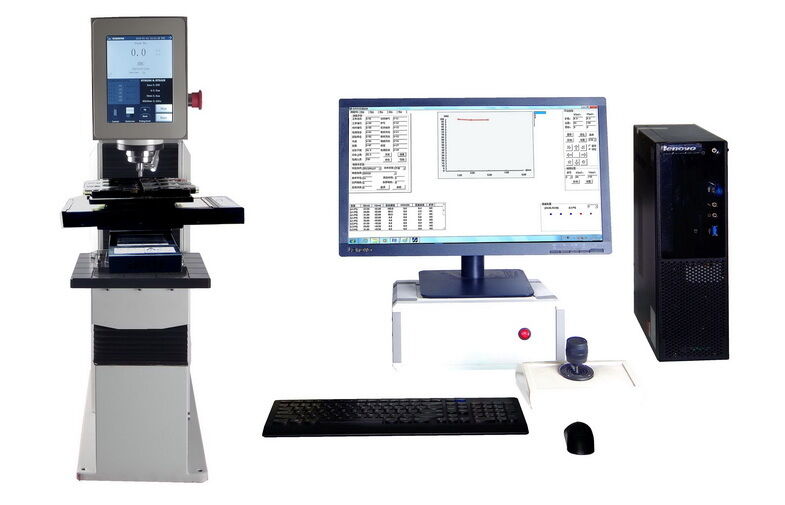
End Quenching Fully Automatic Rockwell Hardness Tester MHRS-150-XYZ
Brief Introduction:
The iqualitrol MHRS-150-XYZ uses high-speed precision step control technology to achieve continuous tracking and control of the force application process throughout the test.
The depth measurement system uses a high-precision displacement sensor, providing a minimum hardness value resolution of 0.1 HR.
The indenter is fixed, and the platform moves up and down to perform the hardness test.
The iqualitrol MHRS-150-XYZ features a novel design, comprehensive functions, convenient operation, clear and intuitive display, and stable performance. The instrument eliminates the need for weights and uses electric loading and unloading of the test force, allowing testing of all Rockwell and superficial Rockwell hardness scales.
This machine supports both fully automatic and manual operation, with XYZ full automatic control, suitable for end-quench testing; an external PC provides data statistics functions, capable of calculating extreme values, averages, standard deviations, and establishing corresponding statistical databases.
During the entire test process, the PC collects pressure and depth data in real-time and exports it for studies such as elastic modulus.
The statistical database allows input of test data from other equipment for combined statistical analysis. Custom test reports can be created according to user requirements, selecting necessary test parameters, results, and chart curves; test results and reports can be transmitted over a network, allowing other computers to access these data for networked management.
End-quench testing is the standard method for determining the hardenability of a certain metal or alloy material. Currently, the commonly used national and international standards are GB/T225, ISO 642, JIS G0561, SAE J406, and ASTM-A-255.
Technical Specifications:
| Model | MHRS-150-XYZ |
| System functions | Fully automatic end quenching, the equipment does not need to be leveled, automatically compensates for sample deformation, and the impact of surrounding environmental vibrations on measurement |
| Executive Standards | GB/T225, ISO 642, JIS G0561, SAE J406, ASTM-A-255 |
| Calibration | Automatic memory calibration data, Automatic; high, medium, low test blocks, |
| Loading System | High-precision step control system |
| Vertical Space | 140mm |
| Depth Throat | 165mm |
| Operation | One-click start, the platform automatically rises directly from any position until it contacts the workpiece, completing the entire testing process automatically. |
| Test Scales | HRA, HRB, HRC, HRD, HRF, HRG, HRH, HRE, HRK, HRL, HRM, HRP, HRR, HRS, HRV, HR15N, HR30N, HR45N, HR15T, HR30T, HR45T, HR15W, HR30W, HR45W, HR15X, HR30X, HR45X, HR15Y, HR30Y, HR45Y |
| Data Output | RS232 |
| X-Y Anvil | Size: 250×160mm, Travel: 100×100mm; Resolution: 0.001mm(1μm), Repeatability: 0.01mm |
| Z Axis | iqualitrol self-developed Automatic platform lifting, automatic lowering and returning, completed with one button |
| Power Supply | AC90-240V, 50-60Hz |
| Dimension & weight | 645*450*740mm, 80Kg |
Main Features:
1. Tests 15 Rockwell and 15 superficial Rockwell hardness scales; force selection linked with hardness scale selection; GO/NG tolerance judgment; correction for cylindrical and spherical test values;
2. Displacement sensor resolution 0.1μm; repeatability accuracy determined at 0.5HR, high-speed step control, fast testing speed;
3. Compliant with standards ASTM E18, ASTM E384, ISO6508, GB/T230;
4. Platform lifting structure, sturdy frame structure; high-precision loading system, effectively preventing force overload;
5. High-precision linear guide rail guidance, allowing continuous measurement through automatic platform retracting function on the worktable;
6. High-definition LCD touch screen operation, menu-style interface; backlit LCD display, automatic data statistics and storage, RS-232 data output interface; built-in printer;
7. Automatic loading and unloading, holding time adjustable.
The principle of end-quench testing:
According to the HRC hardness scale, starting from the quenched end of the end-quench sample, multiple hardness points are measured along the axial direction at certain intervals. A graph is plotted with hardness values on the vertical axis and distance on the horizontal axis, connecting the points to form a continuous curve.
The testing process of the end-quench system is: place the end-quench sample into the rectangular slot on the upper part of the worktable, manually rotate the drum wheel to move the testing platform.
The test platform has a digital scale that synchronously indicates the displacement; starting from the quenched end, measure multiple hardness values along the axial direction at certain intervals according to the HRC hardness scale.
Hardness values are automatically output to the computer via USB and processed using the 'End-Quench Test Analysis Software,' displaying the end-quench curve and various parameters, including hardenability and hardening layer analysis on the computer.
Contact Person: Mr. Andy DAI
Tel: +86-13450058229
Fax: 86-769-2278-4276
| Factory Address:No. 88, Jiaolian Yiheng Road, Wanjiang district, DongGuan, China (523046) | |
| Sales office:No. 88, Jiaolian Yiheng Road, Wanjiang district, DongGuan, China (523046) | |
| +86-769-2217-9727 | |
| q1-test@outlook.com | |